International Green Warrior Olympiad Class 8 Sample Paper
Equip your child with essential environmental knowledge through the International Green Warrior Olympiad Sample Paper for Class 8. This sample paper is designed to boost awareness and understanding of sustainability topics in a structured format.
What's Inside the Class 8 Green Warrior Sample Paper?
Topic-based questions on Climate Action, Life Below Water and Life On Land etc.
Application-driven MCQs to build logical and eco-conscious thinking
Comprehensive answer key for guided practice and evaluation
Download the Class 8 International Green Warrior Olympiad Sample Paper (PDF) and take the first step in preparing for an engaging and informative environmental competition.
Introduction to clean water: Understanding the importance of clean water and proper sanitation, various sources of clean water, methods to purify water, water treatment plans, methods to filtre water
Proper sanitation and personal hygiene: Sanitation and personal hygiene practices and their impact on health, access to clean toilets and sanitation facilities
Waterborne diseases: Common waterborne diseases (e.g., cholera, dysentery), how waterborne diseases spread, prevention through clean water and sanitation
Water scarcity and global water issues: Exploring water scarcity in different regions, the role of climate change in water scarcity
Water pollution and treatment: Sources and types of water pollution, consequences of water pollution, wastewater treatment processes
Water conservation: The water cycle and its importance, strategies for water conservation, technologies for efficient water use
Affordable and Clean Energy
Sources of energy: Exploration of various energy sources (e.g., fossil fuels, renewable energy, nuclear), how energy is generated from different sources, environmental impacts of different energy sources
Renewable energy sources: Introduction to renewable energy sources (e.g., solar, wind, hydro, geothermal), how renewable energy systems work, advantages and challenges of renewable energy
Energy conservation and efficiency: Understanding the importance of energy conservation, practical tips for saving energy at home and school, energy-efficient technologies and practices
Introduction to clean energy: Understanding the concept of clean energy, differentiating clean energy from fossil fuels
Clean energy innovations: Innovations in clean energy technology, solar roadways and smart grids
Environmental impact of fossil fuels: Understanding the environmental impact of fossil fuel use, air and water pollution caused by fossil fuels
Sustainable Cities and Communities
Sustainable transportation and green infrastructure: Introduction to sustainable transportation, the role of electric and hybrid vehicles, bicycles as a sustainable mode of transportation, sustainable urban planning and green infrastructure
Characteristics of sustainable cities: Green infrastructure, urban farming, efficient public transportation, operations on renewable energy sources, waste management
Universal access to safe, inclusive, and accessible green and public spaces
Responsible Consumption and Production
The three r's: reduce, reuse, recycle: Importance of three r's of responsible consumption, strategies to reduce waste and consumption, creative ways to reuse items, introduction to recycling and waste separation
Responsible consumption of water and energy: Importance of conserving water and energy, practical tips for saving water and electricity, energy-efficient appliances and lighting
Responsible consumption of water and energy: Importance of conserving water and energy, practical tips for saving water and electricity, energy-efficient appliances and lighting
Climate Action
Introduction to climate change: Understanding the concept of climate change, differentiating between climate and weather, causes and effects of climate change
The carbon cycle: Understanding the carbon cycle, how humans disrupt the carbon cycle
Earth's climate systems: Introduction to earth's climate systems, the role of the atmosphere and oceans in climate regulation
The greenhouse effect: Explaining the greenhouse effect, how it affects the earth's temperature
Life Below Water
Conservation of marine life: Exploring marine protected areas and marine sanctuaries, importance of marine conservation for biodiversity
Threats to marine ecosystems: Identifying human activities that harm marine ecosystems (e.g., overfishing, pollution, habitat destruction), discussing the impact of climate change on oceans
Marine pollution and plastic waste: Sources and types of marine pollution (e.g., plastic waste, oil spills), impact of pollution on marine life and ecosystems, solutions and cleanup efforts
Life On Land
Introduction to terrestrial ecosystems: Understanding terrestrial ecosystems (e.g., forests, grasslands, deserts), importance of land-based environments
Endangered species and conservation: Introduction to endangered species, conservation efforts to protect endangered species
Major threats to terrestrial ecosystems: Habitat destruction and fragmentation, deforestation, overexploitation, pollution, agriculture practices, etc.
Food Security and Agriculture
Food choices and sustainability: The impact of food choices on the environment, reducing food waste at home and school, sustainable farming practices (e.g., organic, local), composting and its benefits
Climate change and food security: How climate change affects food production and agriculture, strategies for adapting to changing climates in agriculture
A group of scientists is studying the effects of climate change on a mountain grassland ecosystem. They observe that the average temperature in the region has increased over the past few decades, and that the timing of plant flowering has shifted earlier in the spring. How might these changes impact the interactions between plants and pollinators in this ecosystem?
Q.2
Max was studying the Earth's atmosphere in class. He learned about a special layer that shields us from harmful solar radiation. While explaining it to his friend, Sarah, she asked, "What's the name of this protective layer?"
Q.3
In a coastal city, students investigated the impact of nutrient runoff on marine ecosystems. They discovered that agricultural practices contributed to excess nutrients reaching the ocean. How do nutrient runoff and eutrophication affect marine life?
Q.4
The local government introduced a campaign encouraging citizens to repair broken household items rather than replacing them. How does this campaign support responsible consumption and production? 1. Extending the lifespan of products through repair and reuse 2. Promoting continuous purchasing of new products 3. Encouraging constant disposal of items
Q.5
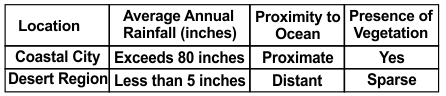
In a study comparing two diverse regions, a Coastal City and a Desert Region, several factors influencing annual rainfall were analysed and recorded in the table below. Based on this information, which of the following statements is most accurate?
Q.6
Your city throws away tons of food, leading to environmental issues and wasted resources. Two groups proposed solutions: Group A: "Community Kitchens": Establish kitchens that collect discarded food, prepare nutritious meals, and serve them to those facing hunger. "Urban Composting Network": Create a network of community composting bins and educational programs to turn food scraps into nutrient-rich soil for urban gardens. Group B: "Smart Fridges": Implement high-tech fridges that monitor food freshness and notify owners to prevent expired waste. "Automated Recycling Plants": Build specialised plants that efficiently process organic waste into fertilisers and renewable energy. Which group's approach do you think will more effectively reduce food waste and address related challenges? Why?
Q.7
At a science camp, Mia learns about solar energy. She analyses data and finds that a solar panel generates an average of 1.5 kilowatt-hours (kWh) of electricity per day. If a household uses 6 kWh of electricity daily, how many solar panels would they need to cover their entire daily energy consumption?
Q.8
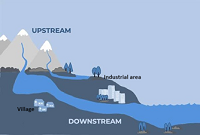
A study in a river basin area shown in the picture reveals that the concentration of heavy metals in the water significantly exceeds permissible limits downstream of an industrial area. What can be inferred from this data?
Q.9
During an Earth Science field trip, students are exploring the impact of rising temperatures on the local ecosystem. The students notice a decline in the population of a particular plant species in the area compared to previous years. Which factor related to climate change is most likely influencing this decline?
Q.10
A country is considering expanding its nuclear energy capacity. Which of the following key environmental considerations they should address before making a decision? 1. Proper disposal of radioactive waste and ensuring plant safety 2. Promoting wildlife conservation in the vicinity of nuclear plants 3. Increasing water usage for cooling reactors
Your Score: 0/10
Answers to Sample Questions from CREST Olympiads:
Q.1
a
Q.2
d
Q.3
a
Q.4
a
Q.5
a
Q.6
d
Q.7
c
Q.8
c
Q.9
a
Q.10
d
Answers to Sample Questions from CREST Olympiads:
Q.1 : a | Q.2 : d | Q.3 : a | Q.4 : a | Q.5 : a | Q.6 : d | Q.7 : c | Q.8 : c | Q.9 : a | Q.10 : d